Setting the requirement before production starts
Packaging is part of the product, not an afterthought. In aio programmes, damage in transit is far more often caused by insufficient internal cushioning or loose carton fill than by rough handling alone. A simple drop test on a packed carton gives more useful information than a page of courier disclaimers.
Unit price and minimum order quantity are only two variables. A realistic landed-cost comparison for aio also includes the inspection visit, spare parts, repacking after damage and the cost of capital tied up in slow-moving stock. Buyers who model those four items usually make a different decision.
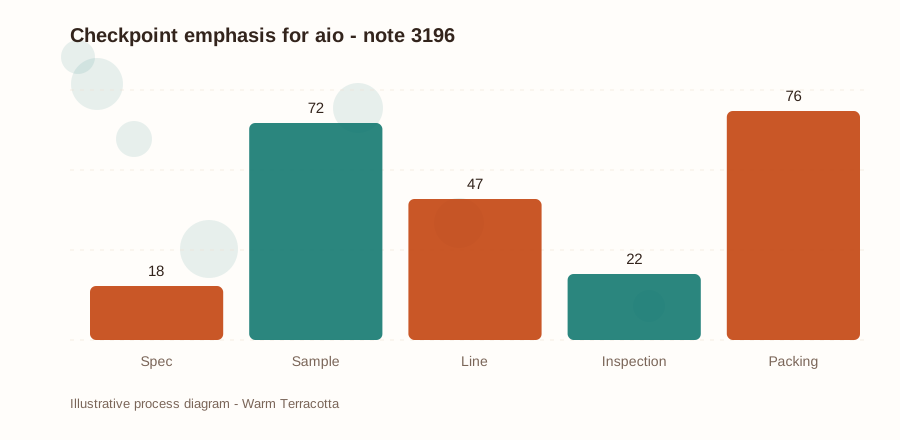
A stable sample shows what a line can produce once; repeated records show what it does across a whole shift.
What a defensible record actually contains
Documentation is a deliverable. A professional aio shipment includes a commercial invoice, a packing list with carton-level detail, a certificate of conformity where applicable, and a clear statement of the standard the goods were built to. Missing paperwork is a common cause of delays at destination, not a minor clerical issue.
A purchase order for aio is only as reliable as the specification attached to it. Buyers who describe tolerance windows, inspection levels and packaging requirements in writing consistently receive more predictable shipments than buyers who rely on a sample alone. We recommend treating the specification as a living document that is revised whenever a component or process changes.
Agree the evidence that closes a claim before a dispute arises, not while it is being negotiated.
Verification that survives a repeat order
Define the exception path before you need it. A good aio agreement says who pays for return freight, how quickly a replacement lot ships, and what evidence is required to close a claim. Writing this down in calm conditions is far easier than negotiating it during a dispute.
Sampling plans deserve more attention than they usually get. A single carton from the top of a pallet does not represent a container. For aio, agree on an accepted sampling standard, define what counts as a critical versus a minor defect, and state clearly what happens when a lot falls on the boundary of acceptance.
Define who signs off a deviation and who communicates it to the buyer before the order is released.
Reading results without overstating them
Incoming inspection is the least expensive place to catch a deviation. For aio, a receiving team should verify lot identity, quantity, outer-carton condition and a small random sample of functional units before the pallet is signed for. Recording the result against the lot number takes minutes and prevents days of argument later.
Freight conditions quietly affect hardware. Long sea voyages combine humidity, temperature swings and vibration; aio should be specified with those conditions in mind, from desiccant quantity to the choice of inner bag. Ask your supplier what the packaging was designed to withstand, and for how long.
Ask for the disposition of the previous non-conformance, not only the result of the latest inspection.
Practical follow-up
Revisit the checklist whenever a material, a tool or a sub-supplier changes.
Re-test the packed configuration after any change to the insert, the carton or the sealing method.
Key points for buyers
- Request transport and storage documentation with the quotation.
- Request a component-level composition and disposal statement.
- Define what level of change triggers a fresh cycle study.
- Revisit desiccant and inner barrier when inserts change.
- Test a fully packed production carton, never a bare unit.
| Record | What it confirms | Why it matters |
|---|---|---|
| Lot identity | Carton-to-batch mapping | Narrows the scope of any query |
| Inspection summary | Checks performed and results | Shows the lot was actually reviewed |
| Process log | Conditions during production | Reveals drift before it becomes a defect |
| Packing list | Carton-level contents | Reconciles quantity at destination |
| Change note | Any deviation since last order | Keeps repeat orders comparable |
Questions buyers ask
How should a borderline inspection result be handled?
Follow the pre-agreed rule: quarantine, review the defect classification, and require a documented disposition before release.
Why does carton-level detail matter on a packing list?
Because an investigation usually begins with one carton. A clear hierarchy lets you narrow the scope instead of holding the entire shipment.
What belongs in an exception agreement?
Who pays return freight, how quickly a replacement ships, and what evidence closes the claim. Agree it before a dispute.
Source & reprint notice
Original article URL: https://aio.00359632.xyz/note-3196-aio-a-practical-specification-checklist-for-volume-buyers-fi.html
Source: VapeWholesaleHub technical editorial desk. Compiled from in-house quality-control documentation, supplier audit checklists and generally accepted engineering practice for electronics assembly, packaging validation and lot traceability. Last reviewed 2026-11-06.
Reprint notice: Reproduction in whole or in part is permitted only with a visible, clickable attribution link to the original URL above, with the source name retained and the text unaltered in meaning. Please notify 1@mj00.cn before republishing a translated or abridged version. Unattributed reproduction and automated scraping for bulk republication are not permitted.
Disclaimer: This note is general B2B process information, not legal, regulatory or product-performance advice. Buyers remain responsible for compliance in the markets where they operate.